
Where Radiant Handwork Lives: The Light of Glass in Nagasaki, Rurian and 538 Stained Glass Studio [Travel Guide vol. 20] GOTO RETREAT ray by Onko Chishin #6
2022 - 10 - 25

We send “Tabisaki Annainin” (Travel Guide), a newsletter focused on the people connected with our inns, to guests who regularly stay at the properties we operate.
Since [vol. 15], we have been running a series on the Goto Islands over several issues. GOTO RETREAT ray by Onko Chishin opened this summer, and the series introduces the “local lights” of the Goto Islands.
(Hotels operated by Onko Chishin: SETOUCHI RETREAT AONAGI, IKI RETREAT KAIRI MURAKAMI, HAKONE RETREAT FÖRE and VILLA, SETOUCHI KEIRIN HOTEL 10, GOTO RETREAT ray)
Nagasaki, Where Japan’s Glass Culture Began
Glass is now indispensable to our lives, yet its history is long. It is said to have been made by humans about 5,000 years ago. Glass was shaped and worked in Japan from ancient times too, but its culture flourished only after the mid-16th century. Techniques and crafts arrived from Portugal in Nagasaki, which had developed as a gateway for overseas trade, and spread across the country.

In this land with deep ties to glass, we met two glass artisans who carry on its culture: Rurian, a glass studio in Nagasaki City that has operated for more than 40 years, and 538 Stained Glass Studio, the only stained glass studio in the Goto Islands. We introduce the radiant handwork woven in the place where glass culture arrived.
In Hot Weather and Cold, Facing Flames Above 1,000 Degrees
It was a June afternoon, humid and muggy, with the rainy season fully under way. We visited Rurian, a glass studio in Nagasaki City.
“It’s a bit hot, I’m afraid…”
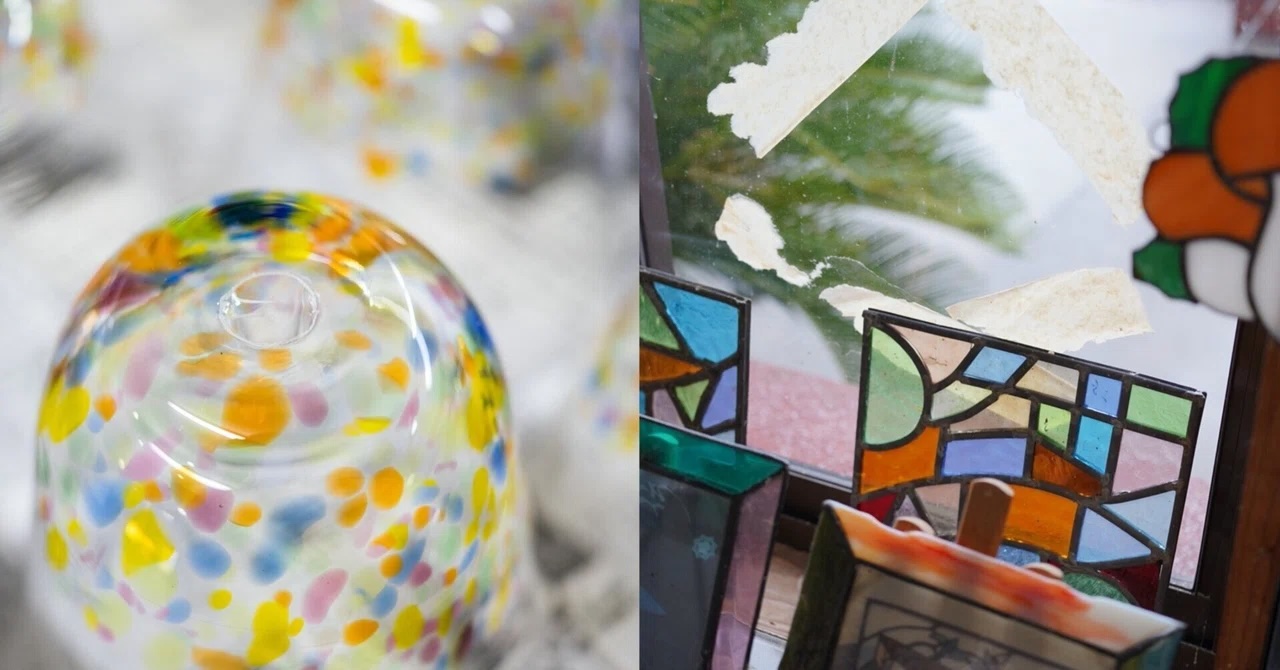
Welcoming us into the studio and shop with a slightly apologetic air was glass artisan Ayato Takeda. At the back of the shop, which combines a studio and a store, artisans were sweating over their blown glass. The large melting furnace that melts the glass burns without pause, at over 1,000 degrees. GOTO RETREAT ray by Onko Chishin in the Goto Islands, Nagasaki, has commissioned original tableware and glasses, used in its guest rooms and restaurant. We came to watch them being made, and the heat of the studio reached the far end of the shop.

Glass artisan Ayato Takeda

Blown glass is made by putting it in the furnace and taking it out, blowing air to change its shape, and layering glass again and again. Near the furnace it is like a sauna, and sweat runs down even when standing still.
“People who make udon or soba say the ingredients are different every day, and glass is the same. Glass cracks when its temperature drops, so in winter there is little time to shape it outside the furnace. In summer you can keep it out longer, but it is a battle against the heat. The glass is over 1,000 degrees, so a single drop of sweat can crack it. It is that delicate, and no two pieces are the same.”
Glass Is Born from the Sea
“What sets Rurian apart is that we start by melting sand to make the glass. Many people these days melt blocks of glass, which is mainstream and also cheaper in gas costs, but by being particular about the raw materials we bring out the beauty.”
As he spoke, he showed us beautiful, soft, silky “sand.” It is one of the most important raw materials for making glass. They now use silica sand from Tasmania, but glass artisans in the Edo period are said to have used sand from Japan’s shores.

“We add various components to the sand to bring out transparency, but if the original sand is not good, nothing can be done. There was a time when Japan’s sand was this beautiful too. Today it is too dirty to use. Around the world, places with beautiful sand are fast disappearing. Perhaps the beauty of the earth and the beauty of glass are always side by side.”
We rarely see the raw material of glass. Learning that it is made from the sand of a beautiful sea, we felt we understood the secret of glass’s watery clarity and sparkle.

“Glass is born from the sea.”
Mr. Takeda’s words sounded wonderfully romantic.
“We Have to Make It in Nagasaki!” Why They Keep Making Here
“Rurian is run by two generations, my father and me. My father originally worked in architecture, but at 37 he left his company, enrolled again at Japan’s first glass college, studied glass from scratch and founded Rurian. At that time, almost all the glass products and souvenirs sold in Nagasaki were made overseas, and almost nothing was made in Nagasaki.”
Seeing that Nagasaki’s glass culture had been lost, his father Katsuto Takeda wanted to “light the flame of Nagasaki glass craft again,” and was drawn into the world of glass. Today his father Katsuto works as a stained glass artisan and his son Ayato as a glassblower. With solid skill and strong commitment, they carry on Nagasaki’s glass culture, including the restoration of Oura Cathedral in Nagasaki City, a World Heritage site.
“Doing it in Nagasaki is our greatest commitment and what gives it meaning. It’s where I was born, it has history, and it can only be here.”

“Keeping a studio in the same place for a long time brings happy moments. A student who tried glassmaking on a school trip became a teacher and brought their own students to the studio. They told me, ‘I could never forget the excitement of that time, and I wanted my students to experience it. I still have the piece I made.’ I felt that through glass, things and feelings are passed on. Objects always hold attachments and stories. I believe that because something is handmade, people want to cherish it and may sense something in it.”

Something we want to cherish: surely it is something that brings the maker’s face to mind each time we use it, or quietly accompanies our own memories. Rurian’s carefully made glass pieces are like that. Thinking of the artisans behind the glass, or of the ancient people who brought glass culture here, we feel we want to use them for a long time with care.
——–[Glass Studio: Rurian]
Address: 5-11 Matsugaecho, Nagasaki City, Nagasaki
TEL: 095-827-0737
Hours: 9:00 a.m. to 6:00 p.m.
Closed: Tuesdays
Website: http://www.rurian.com/
Instagram: https://www.instagram.com/rurian_glass_studios_inc/
——–
The Island’s Only Stained Glass Studio, Tucked into a Corner of Goto
A lone brick building stands before the calm sea. In the Miiraku area in the northwest of Fukue Island is the island’s only stained glass studio. Open the door and you find a small woman facing a large sheet of colored glass. Her earnest gaze makes you hold your breath.

Yumiko Hamasaki of 538 Stained Glass Studio
Welcoming us was Yumiko Hamasaki of 538 Stained Glass Studio, who makes stained glass on the island. The space, surrounded by glass and parts, conveys the immediacy of handwork and is somehow exciting.

Making the Stained Glass of Miiraku Church
The studio started 25 years ago. It was opened by a native of Goto, and at the time a major project was underway to make the stained glass for Miiraku Church in the same area.
“You might think of stained glass when you think of a church, but Miiraku Church had none at all. To be precise, the first church had it, but it seems to have been lost when the church was rebuilt as the second. The person who started the studio felt, ‘It’s so sad. A church really should have stained glass.’ The project began from there.”

About a year after the studio opened, Ms. Hamasaki joined its activities as a student. At first, she wanted to put stained glass in part of her home’s door and joined for personal work after seeing a flyer recruiting students.
“When I joined, there was already talk of making the Miiraku Church stained glass. There were nine members, only two of us including me were Christian, and all were beginners with no knowledge of stained glass or glass. We invited a teacher from Osaka and made it while learning from zero. It was basically volunteer work, so each of us worked when we had time. I was a city hall employee then, so I took part on weekends when I was off. We planned to finish in five years, and it ended up taking six.”

Making stained glass involves painstaking work, such as cutting glass to fine designs, and also physical work, such as bending the hard lead strips called came that hold the glass. Adjustments are made to the millimeter to fit the design.
“Of course I was anxious. The stained glass for the church came to 34 panels in all. I was also working, so I wondered whether I could keep going for five years. But once I finished one, my mindset changed. When I felt the joy of completing it, I truly forgot my fatigue. I was moved by how beautiful it was.”
The stained glass of Miiraku Church expresses the history of Christianity, of Japan, and of Christianity in Goto. Made with the stories of the place poured into the glass, this great work is now a proud symbol of the town.
“It’s Hope. With This, I Can Go On Living.”
The person who started the studio fell ill during the making of the Miiraku Church work and passed away without seeing it completed. Since then, Ms. Hamasaki has been at the center of the studio, restoring and creating stained glass for churches. She had never studied design or craft, but learned the skills and knowledge from the ground up, and now receives made-to-order requests, from design onward, from shops in Goto and elsewhere.

“There is one memorable commission. It was in 2011, after the Great East Japan Earthquake. I received a phone call from a Catholic believer in Iwate Prefecture, who said the tsunami had swept away their home and everything. At their lowest, wondering how to go on living, they recalled the beautiful stained glass of the churches they had seen on a trip to Goto. They said, ‘It’s hope. I thought, with this, I can go on living… I want to put it in my home.’ I wanted to help in some way, so I accepted.”
With the request coming from far away in Tohoku, it was a difficult order. Even so, with the watchword “Here too, support for recovery!”, they stayed in close, persistent contact, and made and delivered four stained glass pieces to Iwate.
“In an age when many people could not yet read, stained glass played a role in conveying thoughts and meanings through color and form. The colors of the glass and the shapes depicted all carry meaning.
When I was thinking about what to make for the person in Iwate, the words ‘the Creation’ came to me. I drew Mary so that she could be protected by the church’s Virgin Mary, a rainbow for the ‘entrance,’ and a bird for the ‘Holy Spirit.’ I put into it the feeling that the storm has passed and peace has come.”

Stained glass in which each motif and color carries meaning, made while thinking of the person who will receive it. Perhaps beautiful glass captivates people because the maker’s quiet prayers are woven into every detail.
I Want to Keep Making: A Life’s Work Found in Adulthood
Ms. Hamasaki worked as a city hall employee while making stained glass, and 15 years ago, at 55, she left her job to focus on the studio. Alongside her work, she now also offers stained glass making experiences for tourists.
“I’d like to contribute something with what I have. I want to keep making. I wonder how long I can…”

Ms. Hamasaki faces the glass quietly and steadily, and speaks of such demanding work as if it were nothing, modestly and a little shyly. What began with a wish to repair the glass in her own front door has made her a glass artisan who now carries on the island’s beautiful culture. She seems to teach us that, at any age, wholehearted perseverance can become a life’s work.
——–[538 Stained Glass Studio]
Address: 806-9 Hamanoaze, Miiraku-cho, Goto City, Nagasaki
Closed: Irregular
*GOTO RETREAT ray by Onko Chishin offers a stained glass making experience as an activity. If you would like to take part, please contact the hotel.
GOTO RETREAT ray by Onko Chishin: 0959-78-5551
For details, please see here.
——–